Tuesday, September 29, 2009

Monday, September 14, 2009

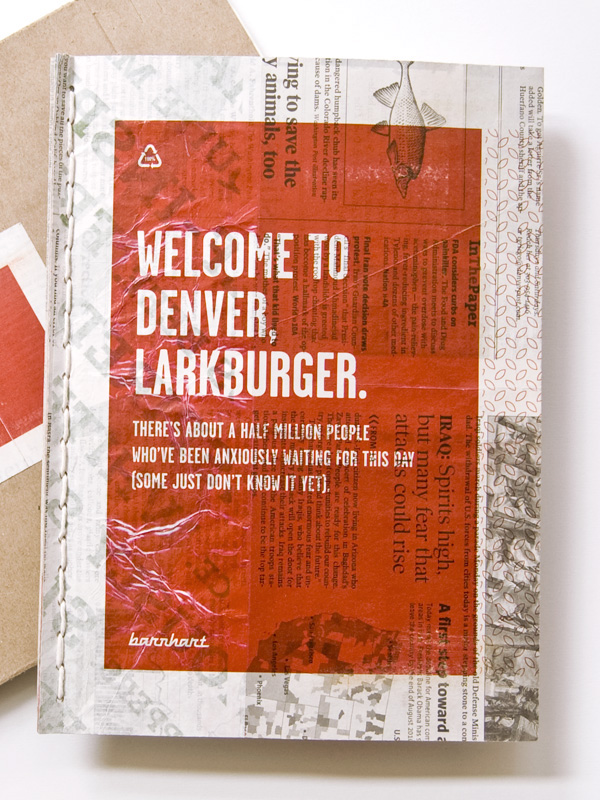
A designer's trashy self-promo book


Last week while I was browsing I found this really cool self-promotion book. It uses used material like wrapping paper, magazine, newsprint... prints over them, and then binds the whole thing with a string. It sounds busy, but the overall effect was quiet sophisticated.

The large red blocks with his messages are superimposed and because it is red over muted colors, his messages are easily separated from the rest. I thought it was a nice touch using actual trash to make something new and environmentally friendly. Not ideal with mass production, but then again, there's so much trash out there, it's possible.

One thing the designer pointed out was his printing process. He nearly jammed and broke his super expensive laser printer with all the glossy/coated paper. Not worth it for a self-promo book with total cost of $2-3.

Here's the original link to his book on the FPO website.

** Forgot to mention that the designer is Jim Hargreaves. 

Monday, March 2, 2009

Poster Design

Poster for the concert event for Taxi Taxi.


This poster used a simple image combination to substitute the letters “x”. The images used are bandages, not clean/new ones, but used, dirty, and pretty bloody too. Though blood is not visible, it seeped through the cotton.
Taxi Taxi is an Indie music group. Used/bloody bandages symbolizes wound, hurt, cut. Perhaps this poster says that they take risks in their music and sometimes accidents happen. Or maybe it’s the location that is dangerous/risky—Brooklyn, New York. Whatever the hidden meanings behind these bandages are, it is obvious that Taxi Taxi is not a classical, conventional group.


Another pretty cool poster I found on the Internet.

The image is too small to see what it is promoting, but I thought I’d put it up since it looks so cool. I like how simple it is and yet so dynamic. Simply breathe.... Sometimes I seem to forget it, but when I saw this poster, I definitely took a moment to relax and breathe.

KU School of Design flash animation

Here is the link for my flash animation. Enjoy!


Sunday, January 25, 2009

Reading 2: Questions/Comments

Comments

Making an original symbol that is stripped down to its bare minimum yet still be instantly recognized is just not easy. In fact, I think it's very difficult. It is amazing how creative people are because there are so many great ones out there.

In our reading assignment, I especially enjoyed the "Understanding Comics." It was very interesting, certainly engaging, and philosophical and deep. It made me think many times and I had to re-read a few times to understand a bit. I can't believe there is so much science behind comics. Who knew...

Sunday, January 18, 2009

Reading 1: Questions/Comments

What does the apple in this picture signify?

In the reading, it said the Bible never mentioned the forbidden fruit to be an apple—the fruit could be anything. How did "apple" become the image of the forbidden fruit? And when? Was it after Cranach painted apples in his Garden of Eden? Or was it already symbolized before his painting?


What does this symbol mean?


The first thing that came to my mind was the Nazi swastika symbol. It is not because I took a Holocaust literature class last semester and the history still swimming in my head. It is because the symbol is associated with the Nazis and their horrible crimes in the 20th century. They used the swastika extensively during the war, and now their symbol is still seen whenever there is a movie about the Nazis. It seems impossible for anyone now to see this symbol as anything but death, murder, and hell.
I knew that the Nazis adapted the swastika from another religion, and after doing more research, the religion is Hinduism and Buddhism. I've seen the symbol on bronze Buddhas statues, however, it was slightly different—no rotation. I was still too young to know about the Holocaust, so it didn't come to my mind.


The symbol bore a positive meaning for more than 3,000 years before the Nazis' years: life, sun, power, luck, harmony... Even during World War I, Germans soldiers wore the symbol to bring good luck—including Jewish Germans fighting for Germany.


Today, the swastika is still commonly seen. Hinduism and Buddhism (and other religions) still use the symbol as peace, health, and luck. Some products produced from China or India had to be pulled from stores in other countries because the products had the symbol on them. They were innocently meant for peace and luck; maybe for China and India, but certainly not in Western countries. Those product/package designers should have thought of that before selling them internationally... The importance of history! I guess I should have paid more attention in those boring history classes.

I found this on the Internet and I find it very interesting and funny, I think anyway.


sources for images:
http://www.klisia.net/blog/swastika.png
http://www.proswastika.org/page.php?2
http://mjr.iki.fi/pics/swastika.png
http://english.epochtimes.com/news/4-9-4/23097.html